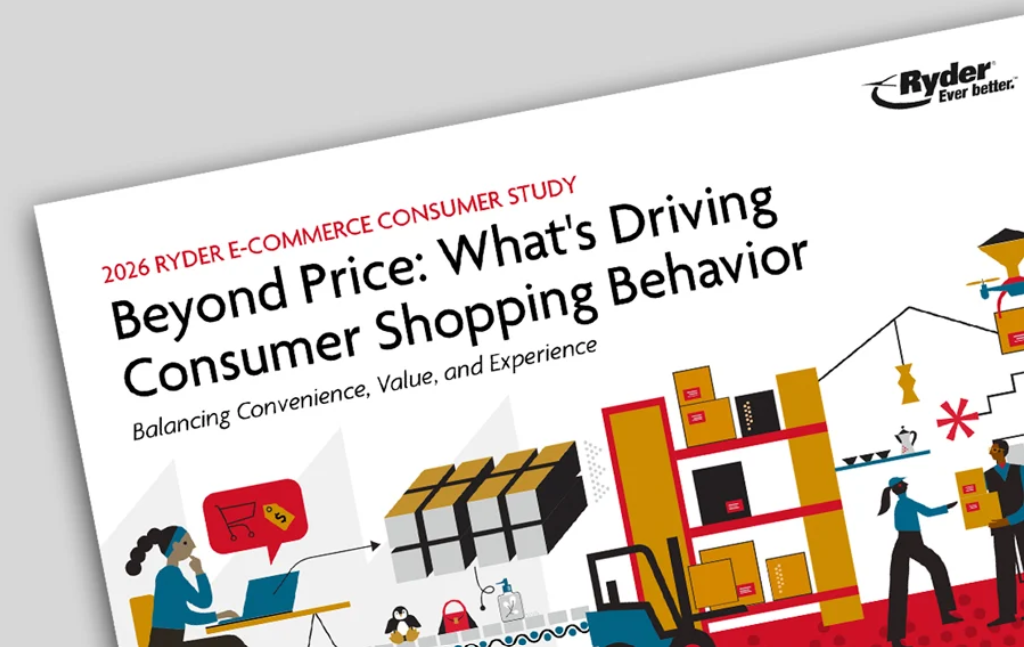
A new consumer survey found a variety of key factors that are driving consumer shopping behavior. Ahead of the holiday shopping season, these results are crucial for retailers looking to stand out against the competition.
Published by Ryder System, Inc., the survey, “Beyond Price: What’s Driving Consumer Shopping Behavior,” examines how consumers balance convenience, cost and experience throughout their shopping journies. Based on a consumer survey of 1,160 U.S. online shoppers conducted in March 2026, the findings highlight that consumers are not choosing between retail channels or buying motives — they are balancing them.
“The retail landscape is becoming increasingly complex, but also more opportunity-rich,” Jeff Wolpov, SVP of Ryder E-commerce and Last Mile, says. “Brands that succeed will balance price with customer experience, deliver seamless omnichannel fulfillment and leverage AI and data-driven insights to meet rising expectations for personalization, visibility and ease.”
AI-Powered Shopping Influences Discovery and Decision-Making
Beyond product discovery, artificial intelligence is increasingly shaping how consumers evaluate and select products, with 64% now using AI-assisted shopping tools, according to the survey. Among these consumers, search and shopping assistants lead adoption (45%), followed by customer review summaries or key takeaways (37%), visual or image-based search (33%), voice assistants (31%), and virtual try-on or visualization tools (31%).
“Industry-wide data echoes our findings, reinforcing that AI is fundamentally changing online shopping behaviors; another study found that nearly three in five consumers have begun replacing traditional search engines with generative AI search,” Wolpov says. “What it all amounts to is, if products are not optimized for AI-powered search results, brands may lose consideration in the consumer buying journey.”
Price Influence Declines in Certain Retail Categories
While price continues to play a significant role in brand consideration and purchase decisions, its influence softened in two retail categories as respondents evaluated additional factors. Among apparel and beauty shoppers, price’s role in purchase decisions decreased 12% and 13%, respectively year-over-year, marking a three-year low for beauty. At the same time, product materials and ingredients, environmental impact, and ethical practices proved to be purchase drivers, cumulatively gaining 13% for each group.
Omnichannel Drives In-Store Sales
Consumers embrace a mix of omnichannel fulfillment options, according to the survey, reinforcing that no single model meets all expectations, creating opportunities for retailers.
A new e-commerce trend emerged this year, as survey respondents’ use of remote locker/location pickup jumped 14%, surpassing Buy Online Pickup In-Store (BOPIS) and curbside pickup as the leading alternative fulfillment option compared to ship-to-home.
At the same time, 86% of consumers have picked up or returned online purchases in-store (+3% YOY), with 52% of that group (+17% YOY) now reporting they often make additional purchases while there, demonstrating the revenue opportunity of integrated omnichannel strategies.
Faster Shipping Expectations Rebound
While free shipping remains the leading factor in purchase decisions (62%), its influence dropped 14% year over year, according to the survey, while fast delivery expectations nearly doubled. Thirty-nine percent of consumers surveyed now expect delivery within one to two days – a four-year high.
Still, 71% of consumers surveyed abandoned items in their carts due to unanticipated shipping fees. Forty-eight percent of consumers research which brands offer free/cheaper shipping, and 73% added items to their carts to qualify for free shipping – the highest since 2023.
Returns Experience Directly Impacts Customer Loyalty and Retention
The survey also found that consumers are nearly split on return method preferences for online orders: among all shoppers surveyed, 52% prefer in-store while 48% prefer to return via mail/drop box. And, among the 79% of respondents who had returns experiences that prevented them from shopping with a brand again, the absence of options to return online orders in-store and via mail were cited equally, highlighting the importance of returns management as part of a seamless omnichannel strategy.
Additionally, among those consumers whose returns experience negatively impacted customer loyalty, the most common complaint was return shipping fees (55%). And, of all consumers surveyed, 52% are unwilling to purchase froma retailer without a free-return policy.